Friday, June 24, 2016

Colonial Vampires: A Mini-Essay

     The plot for Sarah Thomson’s Mercy follows the experiences of Haley Brown, a teenager whose genealogical research reveals that her colonial ancestor, Mercy Brown, was a purported vampire. According to her findings, four of the Brown relatives, including Mercy, contracted tuberculosis and died from the disease. Because their fellow colonists were unable to explain why the affliction struck only the Browns, they exhumed Mercy’s body and discovered fresh blood inside her heart. The evidence, in turn, led many to believe that Mercy was a vampire who fed on her family. Centuries later, as Haley uncovers the story, strange occurrences begin to befall the current Browns. These bizarre acts prompt the teenager to wonder if Mercy truly was a vampire and has returned to feast on her modern relations. Although Thomson’s novel is a work of supernatural fiction, it highlights the current research surrounding accounts of vampirism in colonial New England.
      As David Keyworth explains, the vampire craze which emerged in medieval Slavic lore and quickly consumed much of Europe underwent a slightly different manifestation in colonial New England. The rampant bouts of tuberculosis which plagued the colonies engendered notions of vampirism among parts of the alarmed masses. As communities struggled to understand why the affliction affected only certain households and the relatives of recently deceased individuals, European mythologies carried over from motherlands took charge, leading some to speculate that the corpses of departed souls had returned to drain the life from those family members who, shortly following the vampire’s death, began to exhibit similar symptoms. In fact, the transmission of the disease, as
Nicholas Bellantoni and Paul Sledzik emphasize, played into this mythos. Tuberculosis is easily transferred between individuals living in crowded conditions. The congested and unsanitary accommodations found in many New England farming communities, coupled with seasonal periods of low nutrition, proved ideal for spreading the contagion quickly within households. Hence, one individual would contract and succumb to the disease and, shortly thereafter, other members of the same family would follow suit, leading many to believe that the first victim had returned from the grave to feast upon surviving relatives. Like the fictional Browns in Thomson’s novel, the death of one family member – Mercy – and subsequent infection of others prompted an exhumation of graves, where the blood-filled heart – a product of postmortem decomposition – confirmed suspicions and resulted in the apotropaic remedy (removal and incineration of the heart and destruction of the corpse). 

Works Referenced  

Keyworth, David. “Was the Vampire of the Eighteenth Century a Unique Type of Undead Corpse?” Folklore 117.3 (2006): 241-260.

Sledzik, Paul and Nicholas Bellantoni. “Bioarcheological and Biocultural Evidence for the New England Vampire Folk Belief.” The American Journal of Physical Anthropology 94.2 (1994): 269-274.

Thomson, Sarah. Mercy: The Last New England Vampire. Yarmouth, ME: Islandport Press, 2011.

Friday, June 17, 2016

Rotten Teeth

$5 - $7 (based on 2015 prices)
Makes twelve teeth  

No eccentric laboratory or demented butcher shop is complete without a few rotten teeth scattered around. You can use them to fill unlabeled specimen jars, decorate a gory tablescape, or create fashionable jewelry. Plus, this project is simple and cheap (after making a dozen large teeth, I still had enough compound for other projects). 
  • One 6 oz. container of soft modeling compound*
  • One 2 oz. bottle of acrylic paint in flat black*
  • One 2 oz. bottle of acrylic paint in flat brown*
  • One 2 oz. bottle of acrylic paint in flat white*
  • One 0.44 oz. bottle of clear nail polish*
1. Form the modeling compound into the shape of teeth. It may help to keep a medical book nearby for quick reference. Since human teeth are rather small, you may want to make your versions slightly larger than their real-life counterparts. This ensures that they are easier to see.
2. Allow the compound to dry. I let mine sit out overnight. Do not worry too much if the drying process produces small cracks in the dough. They will be covered up by the paint (or you can use the cracks to make the teeth appear extremely old and worn). 

3. Apply several even coats of white paint to the teeth. I used two; however, you may want more or less depending on your desired coverage. 
4. Give the teeth a smudging of brown paint. You do not want an even coat. Rather, you want a series of lighter and darker hues with areas of white still showing. I found that apply a small amount of paint to your thumb and index finger and rubbing it onto the prop works well. 
5. To give the teeth a little more definition and additional rot, use black paint to fill in fissures along the crown and darken the area around the roots. If you chose not to cover the cracks formed by the drying process, you can enhance their appearance too. 
6. Brush the teeth with one or two coats of clear nail polish to give them a glossy finishing that simulates enamel.

*You will not use the entire bottle’s content for this project.

Friday, June 10, 2016

A Poem from Death's Jest-Book

Published in 1849, Thomas Lovell Beddoes' Death's Jest-Book is a revenge tragedy brimming with deceit, murder, sorcery, and vengeful spirits. Focusing on two brothers (the honorable knight Wolfram and the nefarious duke Melveric), the play, as scholar Michael Bradshaw attests, is Beddoes' magnum opus, in which the author recycles elements from his previous works and refines them into a highly polished masterpiece. During the course of the plot, Melveric, after being rescued by Wolfram during a crusade, turns on his brother and murders him. With the aid of a necromancer, Wolfram returns from the dead to haunt and destroy his conniving sibling. The poem below is whispered to Melveric by a chorus of disembodies voices who eerily remind the traitorous man that vengeance for Wolfram’s unjust death will quickly come. Interestingly, the poem makes a modern - and slightly altered - appearance in Tim Burton's film Beetlejuice (1988) as the incantation read by Otho during the seance scene.

As sudden thunder 

Pierces night; 
As magic wonder, 
Wild affright, 
Rives asunder 
Men’s delight: 
Our ghost, our corpse and we 
Rise to be.

As flies the lizard 

Serpent fell; 
As goblin vizard, 
At the spell 
Of pale wizard, 
Sinks to hell: 
Our life, our laugh, our lay 
Pass away.

As wake the morning 

Trumpets bright; 
As snow-drop, scorning 
Winter's might, 
Rises warning 
Like a sprite: 
The buried, dead, and slain 
Rise again. 

Works Referenced

Beddoes, Thomas Lovell. Death’s Jest-Book. 1829. New York: Routledge, 2003.

Bradshaw, Michael. "Third-generation Romantic Poetry: Boddoes, Clare, Darley, Hemans, Landon." The Cambridge History of English Poetry. Ed. Michael O’Neill. Cambridge: Cambridge University Press, 2010. 542-560.

Friday, June 3, 2016

Gothic Candelabra

$35 - $40 (based on 2016 prices) 
Makes one candelabra with candles  

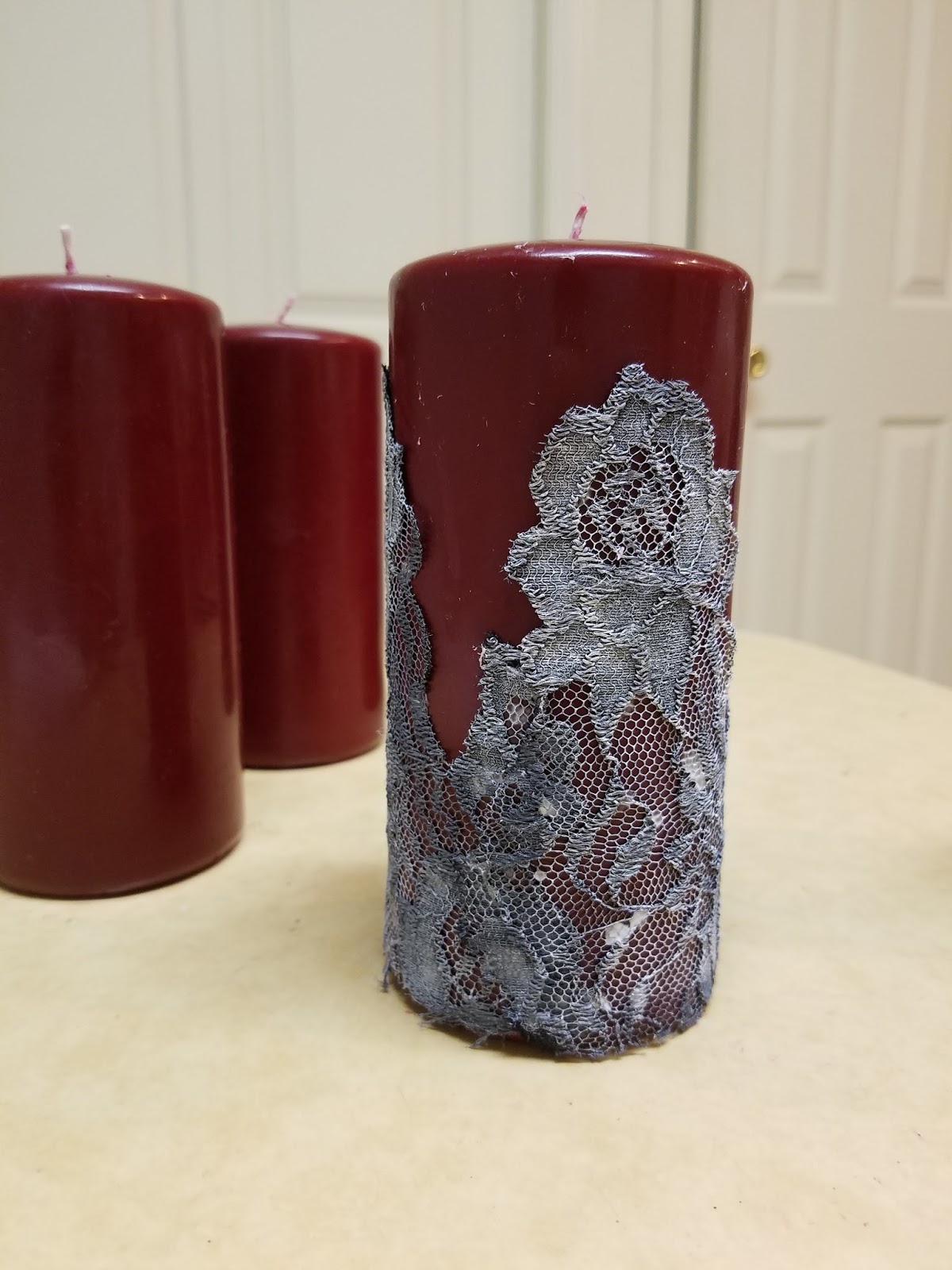
I have always wanted one of those imposing candelabras seen haunting the darkened corners of drafty castles in period films. To my surprise, I discovered one at a second-hand store for $20. My initial attempt to use the lace as a stencil proved an utter mess; however, it gave birth to an entirely new idea. If you cannot find a massive candelabra, the project can still be completed with a smaller version or with a series of candlesticks (buy numerous sticks in various heights and styles from second-hand stores to set an eerie tablescape).
  • One mental candelabra or a set of smaller candlesticks
  • Five candles (or enough to fill your chosen candelabra/candlesticks)
  • One 10 oz. can of interior/exterior, fast-drying spray paint in metallic black
  • One yard of black lace fabric
  • One 8 oz. can of interior/exterior, fast-drying latex paint in flat white*
  • One 16 oz. bottle of isopropyl rubbing alcohol (50%)*
  • One 4 oz. bottle of all-purpose tacky glue*
1. Hold the spray paint can roughly twelve inches away from the candelabra and, in a well-ventilated area, spray it with several even coats of metallic paint. I used three coats; however, you may want more or less depending on your desired coverage. To give the object an antiquated look, use a paint which produces a “hammered” effect.
2. Spread the lace out on a newspaper-lined surface, ensuring that it rests as smooth as possible. With a medium-sized brush, dab the white paint onto the fabric. You want the final product to appear aged and distressed. To achieve this, refrain from applying an even coat. Rather, leave some areas darker than others (the more paint you add, the whiter the lace becomes). You may want to experiment with a few scraps of fabric to perfect the process before beginning the final version.
3. Once the paint has dried, measure the circumference and height of the candles and cut the lace into squares large enough to wrap around them. You can cover the entire candle in fabric or cut out the lace’s designs to create interesting patterns. The latter method may be time consuming, but it produces more dramatic results.
4. Apply a small amount of rubbing alcohol to a paper towel and wipe the surface of the candles. This process removes some of the oils and sheen so the glue can adhere to the wax. To prevent the alcohol from damaging the candles, use a milder strength (50%) or dilute a stronger mixture (70 - 90%) with water.
5. Use the tacky glue to stick the lace to the candles. Because of the curvature, you may have to press and hold the fabric against the candle for a few minutes, allowing the glue to fully adhere to the wax. 

6. After the glue has dried, assemble the candelabra. If you want to enhance the aged appearance of the prop, add further details by brushing the lace with brown paint to simulate dust and patting the structure of the candelabra with rust-colored paint.

*You will not use the entire bottle’s content for this project.

Friday, May 27, 2016

The Dreaded Birth of Twins: A Mini-Essay

     In 1894, Mary Kingsley traveled to Africa as an assistant to the Presbyterian missionary Mary Slessor. During her visit, she witnessed the bizarre banishment of an Eboean slave and her twin babies. As Kingsley describes, the abuse began immediately following the children's birth. Once viewed as a trustworthy and valuable slave, the woman was instantaneously transformed into a monster. All of her possessions - including her prized English china basins - were destroyed, the infants were brutally stuffed into a gin case, and all three souls were bitterly ejected from the village to die in the harsh African wilderness. Although Kingsley and Slessor rescued the outcasts, the villagers perpetually stalked the missionary's house and the mother was placed under constant supervision for attempting to kill her baby (one had already died during the expulsion process). Kingsley was shaken by the ritual and her bewilderment only grew as she discovered the reasoning behind it: superstitions in the Calabar region maintain that twins are the spawn of demonic beings. Hence, the villagers' act of ostracism and the mother's pursuits of infanticide were efforts - all dictated by longstanding beliefs - to destroy these malevolent offspring.
     The Calabar position regarding twins may seem backward; however, it is not unique. Indeed, there is a universal dread of twin births among multiple cultures throughout the world. From tribal societies in Africa, Australia, and East India to aboriginal populations in Europe and North and South America, numerous people perceive the birth of twins as a harbinger of malice and misfortune. Although the rationale behind these cultural fears differ, there is one common theme: infidelity. The Tiwi of Australia, for example, believe that a woman becomes pregnant when a man delivers a pitapitui into her body. Since a man can only produce one pitapitui at a time, the birth of twins serves (erroneously) to prove that a woman has bedded more than one man. In some societies, the assumed adultery is taken at face value and the women is (again, erroneously) punished for her transgressions. In most of these aboriginal communities, though, this inferred infidelity holds a far more sinister connotation. Not only has the woman strayed from her marriage and slept with another man, but this extramarital partner is the tribal approximation of the Devil. Hence, the woman, either knowingly or unknowingly, has allowed herself to become bewitched and impregnated by evil forces, resulting in, as scholar Nancy Caldwell Sorel emphasizes, "a crime guaranteed to call down the vengeance of the gods, who could only be appeased by the death of at least one twin, often both, and frequently the offending mother as well."

Works Referenced

Caldwell Sorel, Nancy. Ever Since Eve: Personal Reflections on Childbirth. Oxford: Oxford University Press, 1984.

Kingsley, Mary. Travels in West Africa. London: Macmillan and Company, 1897.

Tuesday, May 17, 2016

Pretzel Bones

$15 - $20 (based on 2016 prices) 
Makes fourteen pretzels  

Every Halloween party needs spooky snacks and I’m always on the hunt for ways to transform common recipes into ghoulish treats. The idea behind this project is rather simple: take a basic pretzel recipe and mold the dough into bone shapes. To give the snack a creepier touch, use food coloring to dye the cheese sauce a moldy green or gory red. Also, for the time-pressed haunter who hates to cook, the process can be streamlined by using a store-bough pretzel mix.
  • 4 Cups all-purpose flour
  • 2 Tablespoons sugar
  • 1 ½ Teaspoons salt
  • 1 Package active dry yeast
  • 1 Cup milk
  • ½ Cup water
  • 2 Tablespoons vegetable oil
  • ½ Cup baking soda
  • 2 Tablespoons coarse sea salt
1. In a large bowl, combine salt, sugar, undissolved yeast, and two cups of flour.
2. In a small saucepan, gradually warm milk, oil, and water over medium heat until the mixture reaches 130°F (do not boil the liquids). 

3. Stir the warmed milk mixture into the flour mixture, adding additional flour to make the dough soft and malleable. Cover the dough with a tea towel and allow it to rest for twenty-five minutes.
4. Divide the dough into fourteen equal pieces and form each piece into a bone shape (or other Halloween-themed designs). To prevent the dough from drying out, keep the pieces covered with a tea towel.
5. Preheat the oven to 400°F and, in a large pot, dissolve the baking soda in four cups of water, bringing the mixture to a boil. With a slotted spoon or spatula, transfer each pretzel – one at a time – to the boiling liquid and allow it to soak for fifteen seconds.
6. Place the pretzels on a greased baking sheet, sprinkle their surface with coarse sea salt, and bake them for ten minutes or until they become golden brown.
7. Remove the pretzels from the baking sheet and allow them to cool on a wire rack.

Friday, May 13, 2016

"Der Erlkönig" (A Poem)


I first stumbled on Johann Wolfgang von Goethe's poem, "Der Erlkönig," over a decade ago when I heard it recited in French at a local open-mic night. Although the individual was exceedingly melodramatic in his recitation and the atmosphere was heavy with pseudo-intellectualism, the haunting imagery of Goethe's text - a testament to the author's talent - overpowered everything:
"Mon père, mon père, n’entends-tu donc pas...." Written in 1782, the work utilizes the longstanding myth of der Erlkönig - the King of the Alders who haunts the gnarled woods of Germany and claims the hapless souls who venture into its darkened recesses - as a means to explore the menacing encroachment of death. More than that, though, the poem, as Marina Warner emphasizes, "personifies death as a danger above all to the young, who are credited with more intense perception of the other world in the first place; this intimacy with the supernatural makes them vulnerable to its charms and its desires." Presented here is Sir Walter Scott's definitive English translation from 1797.

The Earl-King

O who rides by night thro' the woodland so wild? 

It is the fond father embracing his child; 
And close the boy nestles within his loved arm, 
To hold himself fast, and to keep himself warm. 

"O father, see yonder! see yonder!" he says; 
"My boy, upon what dost thou fearfully gaze?" 
"O, 'tis the Erl-King with his crown and his shroud." 
"No, my son, it is but a dark wreath of the cloud." 

          [The Earl-King Speaks] 
"O come and go with me, thou loveliest child; 
By many a gay sport shall thy time be beguiled; 
My mother keeps for thee many a fair toy, 
And many a fine flower shall she pluck for my boy." 

"O father, my father, and did you not hear 
The Erl-King whisper so low in my ear?" 
"Be still, my heart's darling--my child, be at ease; 
It was but the wild blast as it sung thro' the trees." 

          [Earl-King] 
"O wilt thou go with me, thou loveliest boy? 
My daughter shall tend thee with care and with joy; 
She shall bear three so lightlyt thro' wet and thro' wild, 
And press thee, and kiss thee, and sing to my child." 

"O father, my father, and saw you not plain 
The Erl-King's pale daughter glide past thro' the rain?" 
"Oh yes, my loved treasure, I knew it full soon; 
It was the grey willow that danced to the moon." 

          [Earl-King] 
"O come and go with me, no longer delay, 
Or else, silly child, I will drag thee away." 
"O father! O father! now, now, keep your hold, 
The Erl-King has seized me--his grasp is so cold!" 

Sore trembled the father; he spurr'd thro' the wild, 
Clasping close to his bosom his shuddering child; 
He reaches his dwelling in doubt and in dread, 
But, clasp'd to his bosom, the infant was dead. 

Works Referenced

Scott, Walter. "The Earl-King." The Poetical Works of Sir Walter Scott. Vol. 5. Ed. John Dennis. London: George Bell and Sons, 1982. pp. 139-140. 

Warner, Marina. Monsters of Our Own Making: The Peculiar Pressures of Fear. Lexington, KY: The University of Kentucky Press, 2007.