Friday, March 10, 2023

"The Fairy Thorn" (A Poem)

Born on March 10, 1810, in Belfast, Ireland, Samuel Ferguson became an accomplished poet who used his interests in Irish mythology as the inspiration for much of his work, joining writers like William Butler Yeats as champions of Irish culture.[1] In “The Fairy Thorn,” Ferguson draws from Ulster folklore to write about Anna Grace, who is lured into the woods by the fairies associated with the mythical tree.[2]
 
“Get up, our Anna dear, from the weary spinning-wheel;
For your father’s on the hill, and your mother is asleep;
Come up above the crags, and we’ll dance a Highland reel
Around the Fairy Thorn on the steep.” 
 
At Anna Grace’s door ’twas thus the maidens cried,
Three merry maidens fair in kirtles of the green;
And Anna laid the rock and the weary wheel aside,
The fairest of the four, I ween. 
 
They’re glancing through the glimmer of the quiet eve,
Away in milky wavings of neck and ankle bare;
The heavy-sliding stream in its sleepy song they leave,
And the crags in the ghostly air. 
 
And linking hand-in-hand, and singing as they go,
The maids along the hillside have ta’en their fearless way,
Till they come to where the rowan trees in lonely beauty grow
Beside the Fairy Hawthorn grey. 
 
The Hawthorn stands between the ashes tall and slim,
Like matron with her twin grand-daughters at her knee;
The rowan berries cluster o’er her low head grey and dim
In ruddy kisses sweet to see.
 
The merry maidens four have ranged them in a row,
Between each lovely couple a stately rowan stem,
And away in mazes wavy, like skimming birds they go,
Oh, never carolled bird like them!
 
But solemn is the silence on the silvery haze
That drinks away their voices in echoless repose,
And dreamily the evening has stilled the haunted braes,
And dreamier the gloaming grows. 
 
And sinking one by one, like lark-notes from the sky,
When the falcon’s shadow saileth across the open shaw,
Are hushed the maidens’ voices, as cowering down they lie
In the flutter of their sudden awe. 
 
For, from the air above and the grassy ground beneath,
And from the mountain-ashes and the old white-thorn between,
A power of faint enchantment doth through their beings breathe,
And they sink down together on the green. 
 
They sink together silent, and stealing side to side,
They fling their lovely arms o’er their drooping necks so fair,
Then vainly strive again their naked arms to hide,
For their shrinking necks again are bare.
 
Thus clasped and prostrate all, with their heads together bowed,
Soft o’er their bosoms beating—the only human sound—
They hear the silky footsteps of the silent fairy crowd,
Like a river in the air gliding round. 
 
Nor scream can any raise, nor prayer can any say,
But wild, wild the terror of the speechless three—
For they feel fair Anna Grace drawn silently away,
By whom they dare not look to see. 
 
They feel their tresses twine with her parting locks of gold,
And the curls elastic falling, as her head withdraws.
They feel her sliding arms from their trancèd arms unfold,
But they dare not look to see the cause; 
 
For heavy on their senses the faint enchantment lies
Through all that night of anguish and perilous amaze
And neither fear nor wonder can ope their quivering eyes,
Or their limbs from the cold ground raise;
 
Till out of night the earth has rolled her dewy side,
With every haunted mountain and streamy vale below;
When, as the mist dissolves in the yellow morningtide,
The maiden’s trance dissolveth so.
 
Then fly the ghastly three as swiftly as they may,
And tell their tale of sorrow to anxious friends in vain—
They pined away and died within the year and day,
And ne’er was Anna Grace seen again.[3]
 
Works Referenced 
 
Brown, Malcolm. Sir Samuel Ferguson. Cranbury, NJ: Associated University Presses, 1973. 
 
Denman, Peter. Samuel Ferguson: The Literary Achievement. Savage, MD: Barnes and Noble Books, 1990. 
 
Ferguson, Samuel. “The Fairy Thorn.” The Poetry of Sir Samuel Ferguson. Ed. Justice O’Hagan. Dublin: M.H. Gill and Son, 1887. 48-49.
____________________
[1] Brown, 17-18.
[2] Denman, 17-18.
[3] Ferguson, 48-49.

Friday, March 3, 2023

Laboratory Lights

$30 - $40 (based on 2020 prices)
Makes two lights 
 
Lighting is one of the most overlooked aspects of haunting and one of the main aspects that can destroy a display. If overdone, it can quickly ruin the show by revealing all of the tricks; if underdone, it can hide everything in a blanket of shadows. Over the years, I have tried to prefect the fine balance between too much and too little light: just enough to set the mood and cover imperfections. These lights were part of this process for 2020’s laboratory. I could put them in sections where I wanted additional light to illuminate specific props meant to draw the guests’ attention.
  • Two Edison glass cloche table lamps (roughly twelve inches tall)
  • One 10 oz. can of interior/exterior, fast-drying spray paint in flat black*
  • One 2 oz. bottle of acrylic paint in metallic bronze*
  • One 2 oz. bottle of acrylic paint in olive*
  • Two pieces of white copy paper with vintage advertisements printed on them
  • One piece of yellow copy paper with electrical warning signs printed on it
  • Four tablespoons of black tea (e.g. Darjeeling, Earl Gary, English Breakfast)
  • At least four tablespoons of dark roasted coffee grounds
  • One pan large enough to soak the copy paper
  • One 4 oz. bottle of all-purpose tacky glue*
  • One bag of plastic gears in varying sizes (roughly sixteen gears per bag)
  • One 8 oz. can of oil-based interior wood stain in Jacobean*
1. Remove the glass cloches from the lamps, cover their bulbs with plastic, and, on a newspaper-lined surface in a well-ventilated area, give their bases two even coats of black spray paint. Although I used two coats, you can use more or less depending on your desired coverage. Keep in mind, though, that this is the base coat and much of it will be covered by other paints during step two.
2. Once the paint has dried, detail the bases by apply a layer of metallic bronze. You want to give the illusion of worn metal, so gently brush the paint along the raised surfaces in a quick, back-and-forth motion. It may work best to experiment with a scrap of cardboard first. Also, to enhance the aged patina, randomly smudge olive paint on the bases with either a paper towel or sponge.
3. Boil enough water to completely submerge the two sheets of paper with vintage advertisements printed on them and pour it into the pan. Add the tea. The longer you allow the tea to brew, the darker the stain will become. Likewise, greater amounts of tea will produce a richer stain. I found that a combination of English and Irish Breakfast brewed for over ten minutes produces a nice, deep brown. Submerge the paper into the tea mixture and soak it until it reaches the color you desire. I soaked mine for eight hours and scattered the loose-leaf tea over the top of the paper to add spots. Remove the paper from the water and allow it to dry. Although it can be time consuming, this process works best if you stain each sheet of paper individually.
4. Cut or tear apart the paper. You can either isolate distinct images or use random sections. Cover the surfaces of the bases with the cuttings. This process works best if you move in stages: apply a layer of glue to one section, press the paper down until it sticks, and repeat the process.
5. Accent the bases with plastic gears, using superglue for a sturdier hold. You can either arrange them randomly or strategically place them in clusters. Also, you can use wood stain to give them a grimier appearance.
6. On a newspaper-lined surface in a well-ventilated area, paint the cloches with the wood stain. I discovered that applying a thin coat and patting it with paper towels produces a hazed appearance. Likewise, brushing the rims with a swift downward motion creates the illusion of grime buildup.
7. Once the stain has dried, reattached the cloches to their bases. If you do not plan to access the bulbs, you can glue the cloches in place to prevent them from sliding off during the haunt.
8. Using the procedures in step three, coffee stain the paper with electrical warning signs. I elected to stain these with coffee rather than tea to give the labels a hue which contrasted with the tea-stained advertisements. You, of course, are free to just stain everything with either tea or coffee to save time.
9. After the paper dries, cut out the labels, leaving a small border around their edges, and roughen their surfaces with sandpaper. Then, glue them to the cloches. As you do so, try not to obscure too much of the lights, since this will dampen their glow and hide them.
10. The props can be enhanced further with additional details to cater them to your haunt’s theme, such as a swarm of insects crawling across the glass or a collection of aged bones scattered across the bases. 
*You will not use the entire bottle’s content for this project.

Friday, February 24, 2023

Wang Ch’ung and Ghosts: A Mini-Essay

     Born in 27 C.E., the Chinese philosopher Wang Ch’ung, as scholars like Chang Chih-Lien attest, was the Chinese contemporary of the Roman philosopher Seneca, living during roughly the same time and being just as influential in his thinking.[1] In chapter three of book twenty within his collection of philosophical writings, known as Lun-Heng, Ch’ung contemplates life after death and uses reason to argue against the existence of ghosts. As the thinker contends, there are three major factors which disprove spirits. First, the number of individuals who have died over the course of humanity’s history is numerous, which means there should be a congested throng of ghosts wandering the earth. Due to this overwhelming amount, ghost sightings should be fairly common; however, only a handful of individuals have seen them and, when they do, it is only one or two entities, not a massive crowd. Second, once a fire has reduced wood to ash, it is nearly impossible to rekindle the flame. A new fire can be lit with new wood, but it is not the same as the previous blaze. According to Ch’ung, the same logic can be applied to death. Once the physical body has become dust, nature cannot make the person reappear. Like the fire, it can start a new lifeform, but that individual will not be the same as the deceased. Third, we are not cognizant of what occurs around us while we sleep; therefore, the philosopher stresses that we are also not conscious during death to hear or see what happens following our demise. Because of this, the idea of ghosts returning to correct injustices or seek vengeance is improbable.[2]
 
Works Referenced
 
Ch’ung, Wang. Lun-Heng. Vol. 1. Trans. Alfred Forke. New York: Paragon Book Gallery, 1962. 
 
Chih-Lien, Chang. “Wang Chong as a Critic.” Cina 15 (1979): 11-26.
____________________
[1] Chih-Lien, 11.
[2] Ch’ung, 64.

Friday, February 17, 2023

Graveyard Cake

$10 - $15 (based on 2019 prices)
Makes one cake 
 
Sometimes mistakes can lead to unexpected and pleasant surprises. That was the case for this graveyard cake I made for a friend’s party. I originally intended to make a burial plot with a chocolate sheet cake; however, it crumbled while removing it from the pan, so I quickly decided to piecemeal it back together and add cherry filling for blood. 
 
Chocolate Cake
  • 2 ⅓ Cups flour
  • 1 Tablespoon baking powder
  • ¼ Cup cocoa powder
  • ¾ Teaspoon salt
  • 1 ½ Cups sugar
  • ½ Cup butter
  • 3 Eggs
  • 1 Cup milk
  • 1 Teaspoon vanilla
  • One six-ounce container of cherry yogurt
Cherry Filling
  • ½ Cup sugar
  • 1 Teaspoon lemon juice
  • ½ Cup water
  • 3 Tablespoons corn starch
  • 5 Cups pitted cherries
Decorations
  • 32 Ounces crushed Oreo cookies
  • Five small yellow artificial lilies
  • Three large white artificial lilies
  • Three artificial leaves
  • One plastic skeleton hand
1. Preheat the oven to 350°F and then, in a large bowl, sift together the baking powder, cocoa powder, flour, salt, and sugar.
2. Add the butter, cherry yogurt, eggs, milk, and vanilla to the dry ingredients and beat with a hand mixer on low for three minutes until the batter is well blended.
3. Pour the batter into a greased rectangular baking pan and bake for thirty minutes or until a golden brown and a toothpick inserted in the center comes out clean.
4. As the cake bakes, thoroughly wash and dry the leaves, lilies, and skeleton hand, since these items will be used to decorate the cake and need to be food safe.
5. Once the cake is baked, remove it from the oven and allow it to cool for at least ten minutes. Then, remove it from the pan, transfer it to a large baking sheet (or whatever platter you plan to serve it on), and break apart the middle, creating a mound with the pieces.
6. In a food processor, mince the Oreo cookies. You can chop them into fine crumbs or leave larger chucks to give the dirt a more realistic look. To prevent the cake from being too sweet, remove the cream. After this, line the outside of the cake with the fake dirt and dust the mound with the remaining pieces.
7. To make the cherry filling, begin by mixing corn starch and water together to form a paste. Then, in a large saucepan, cook the cherries, lemon juice, paste, and sugar on a stovetop until the concoction thickens. After this, you will need to chill the filling in the refrigerator for at least twelve hours before use. It might be best to perform this step first or the night before. For the time-pressed haunter, a can of store-bought pie filling will also work. After the filling is chilled, fill the mound with the mixture and pour it along the edges of the cake to look like blood. You can also reserve extra to garnish each slice once the cake is cut and served.
8. Position the leaves and lilies around the cake and insert the skeleton hand into the mound. You can also add further accents like a small ceramic tombstone or fake bugs (since these will also need to be food safe, you will want to thoroughly wash them along with the other decorative elements in step four). 

Friday, February 10, 2023

"The Death Potion" (A Poem)

From “The Deserted House” and “All Hallows Night” to “The Dead Ship” and “A Rhyme of Death’s Inn,” the occult was a major theme in the poetical works of Lizette Woodworth Reese. In this poem, the author explores the role of the jilted lover, who concocts a death potion for the woman who stole her beloved away. 
 
In Italy, 15—.
 
One drop of this, and she will not know
If she be foul or fair;
One drop, and I may bind him again
With a thread of my golden hair.
(Hear, Lord Jesus!)
 
I would that those folk across the street,
In old St. Simon’s there.
Would hush their noise: for they sing so sweet
They make this rare drop seem less rare.
(Hear, Lord Jesus!) 
 
It is May; my plum trees five
Down in the court below
Look like five little chorister boys
Tiptoe to chant, so white they blow.
(Hear, Lord Jesus!) 
 
And a butterfly like a violet
Flits through the sun and lights on the sill
Close to my hand. Are the bees about,
Or is it the wind comes down the hill?
(Hear, Lord Jesus!) 
 
But what have I to do with the May,
Or any other weather?
Or with five white plum trees? Hate and I,
And I and Hell, be yoked together.
(Hear, Lord Jesus!)
 
(One drop is sure to kill.) When she dies,
They will put the cross on her breast,
And get the golden candlesticks out
For her head and feet, and call her blest.
(Hear, Lord Jesus!)
 
But she is a thief! Do ye hear me in Heaven?
Her soul shall not come in
To those white souls. She is pitch, not snow.
Saint Simon, Saint Simon, is Theft not sin?
(Hear, Lord Jesus!)
 
For he was mine, and I was his;
(Hear, Lord Jesus!)
Though we had shame, yet had we bliss.
(Hear, Lord Jesus!) 
 
I fell, but for love, love, love;
And for love, love, love, I swear!
I, for this man and my love,
Would have wiped his feet with my hair!
(Hear, Lord Jesus!) 
 
This robber came; she lay in wait;
She sprang upon him unaware;
He thinks to wed her with a ring
To-morrow in St. Simon’s there.
(Hear, Lord Jesus!) 
 
One drop? And she shall have it then;
In a sup of her lover’s wine;
So — old things will come back again,
And I be his, and he be mine!
(Hear, Lord Jesus!)[1]
 
Works Referenced 
 
Reese, Lizette Woodworth. “The Death Potion.” A Handful of Lavender. Boston, MA: Houghton, Mufflin, and Company, 1891. 37-39.
____________________
[1] Reese, 37-39.

Friday, February 3, 2023

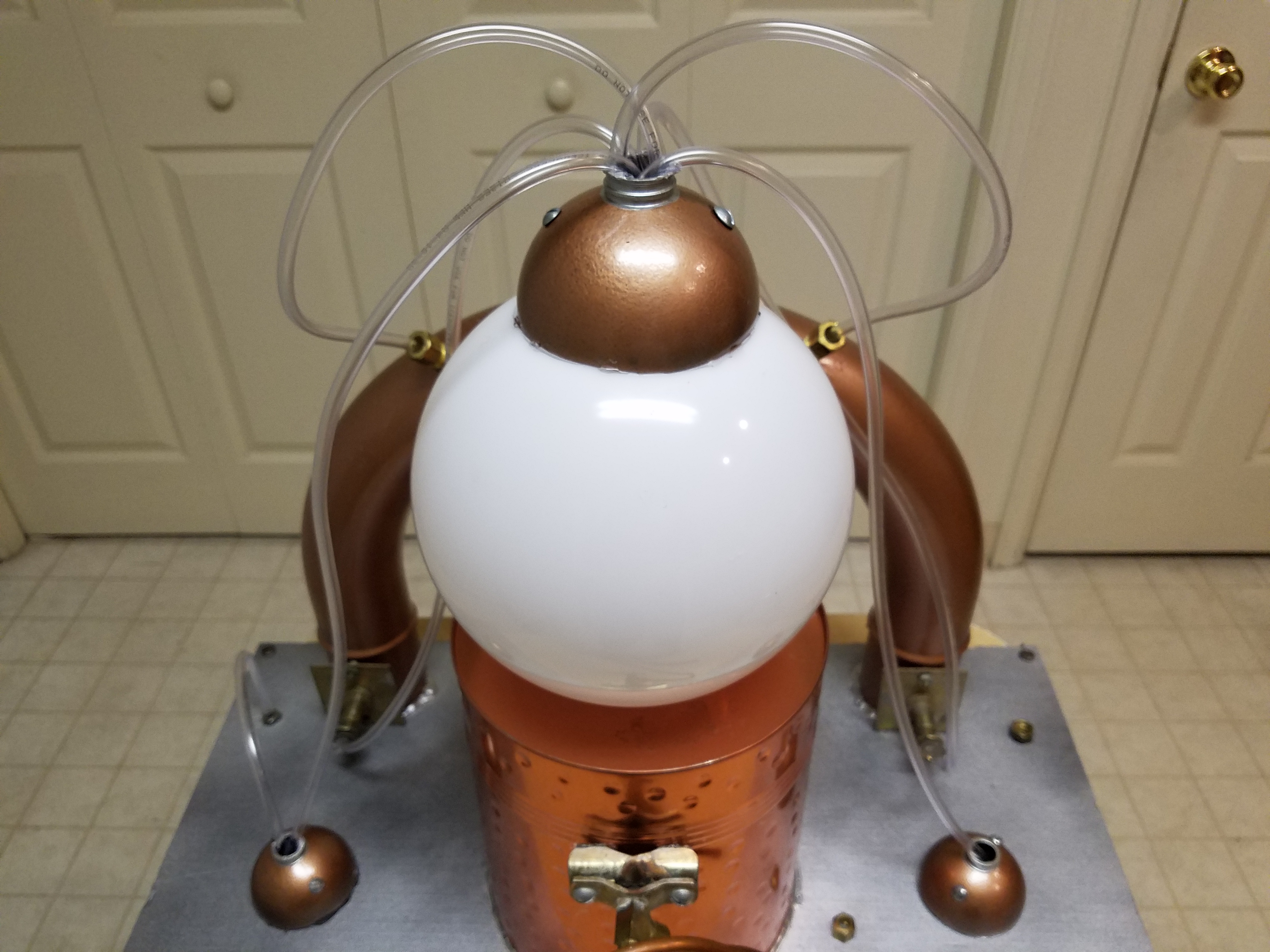
Mind Control Device

$40 - $50 (based on 2020 prices)
Makes one device
 
2020’s mad scientist haunt was a massive undertaking, with the laboratory needing several large pieces of equipment to truly sell the theme. To create a unified set, I decided to use similar elements in all of the pieces: copper and silver pipes and joints, lights fashioned out of Christmas ornaments, and steel-colored bases. For this version, I repurposed an old cookie jar and LED light to make a hypnotizing device the scare-actor could use to control the minds of guests.
  • One 12” x 24” board of foam insulation
  • One 10 oz. can of interior/exterior, fast-drying spray paint in flat black
  • One 10 oz. can of interior/exterior, fast-drying spray paint in metallic copper
  • One 10 oz. can of interior/exterior, fast-drying spray paint in metallic silver
  • One 4 oz. bottle of clear, all-purpose tacky glue gel*
  • A random assortment of bolts, caps, rollers, and screws
  • One eighteen-inch critter tube
  • Five metal spickets
  • One nine-inch metal cookie jar (the lid is not required)
  • One plastic, eight-inch frosted light fixture with a three-inch fitter
  • One battery-powered LED light
  • Two clear plastic Christmas ornaments (two inches in diameter)
  • One clear plastic Christmas ornament (four inches in diameter)
  • One 2 oz. bottle of acrylic paint in metallic silver*
  • Thirteen feet of 1/4” clear plastic tubing
1. On a newspaper-lined surface in a well-ventilated area, build up layers of black and metallic silver spray paint to give the foam board the look of steel. I found it works best to apply a base coat of black to the entire prop and then add the sliver, working in quick bursts to allow parts of the black to remain visible. You can also touch up portions with additional blasts of black if the silver becomes too heavy.
2. Detail the board with the assortment of bolts and screws, applying a small dab of glue to the bottoms of their heads and pushing them into the foam. Your arrangement is entirely based on your chosen aesthetic, so you can apply as many or as little as you like.
3. On a newspaper-lined surface in a well-ventilated area, give the critter tube two even coats of metallic copper spray paint. You can always vary the color to cater the prop to your haunt’s distinct color scheme.
4. Once the paint has dried, use a 5/16 bit to drill four holes into the tube: two at the base and two toward the top. Then, screw a spicket into each hole. For added security, you can coat the threads with glue beforehand.
5. Position the tube on the board and attach it with hot glue. You may need to use a collection of sturdy objects to help support the tube while the glue fully dries.
6. On a newspaper-lined surface in a well-ventilated area, give the cookie jar two even coats of metallic copper spray paint to match the tube and, once the paint has dried, use a 5/16 bit to drill two holes into the container. As with step three, you can use an alternate color for this item to adhere to your haunt’s color pallet. After this, screw the last spicket into the holes, covering the threads with glue for additional support.
7. Using a pair of sharp clippers or scissors, cut a three-inch hole in the bottom of the jar large enough to accommodate the light fixture’s fitter. Because the metal will be sharp, it is best to wear safety gloves during this process.
8. Insert the fitter of the light fixture into the hole and glue it in place. It is best to purchase a plastic version of this item to prevent it from breaking during the assembly or while in use inside the haunt.
9. Determine where the cookie jar will sit on the board and mark its center. Then, place the LED light on this spot and trace its outline. With a sharp knife, cut out the hole, insert the light into its opening, and glue the item in place. You want to be able to access the battery compartment and on-off switch from the bottom of the prop.
10. Position the jar in front of the tube and glue it in place. You want to leave enough room between the container and the spickets to accommodate the tubing, so do not place them too close.
11. Cut the tops off of the Christmas ornaments and, on a newspaper-lined surface in a well-ventilated area, give them a coat of metallic copper spray paint. Once this has dried, accent their tips with metallic silver paint, cut two small holes on either side, and insert screws into the openings. Then, glue the larger ornament to the top of the light fixture and the smaller versions on either side of the jar, ensuring there is enough space for the tubing.
12. Cut the tubing into six twenty-four-inch sections, glue them to the four spickets on the tube and the two smaller Christmas ornaments on either side of the jar, and then run them up into the larger Christmas ornament on the top of the light fixture. You may need to trim the tubing if it is too long to prevent the excess from bunching up inside the prop.
13. Glue a bolt in the space between the critter tube and the small Christmas ornaments, cut two six-inch sections of tubing, and run them between the items, gluing them in place. As with step twelve, you might need to trim the tubing if it is too long.
14. The prop can be enhanced with additional details to cater it toward your haunt’s needs, like swarms of cockroaches crawling across the board or green slime filling the tubes. 
*You will not use the entire bottle’s content for this project.