Friday, November 11, 2022

"The Death Coach" (A Poem)

Thomas Crofton Croker’s The Legends and Traditions of the South of Ireland (1825) is considered one of the most influential texts in shaping mainstream society’s perceptions of Irish folklore, impacting everything from the fairy to the leprechaun.[1] In “The Death Coach,” the author builds on the myth of the Dullahan and its cóiste-bodhar, a coach drawn by headless horses which serves as a harbinger of misfortune.[2]
 
'Tis midnight! — how gloomy and dark!
By Jupiter there ‘s not a star! —
‘T is fearful! — ‘t is awful! — and hark!
What sound is that comes from afar?
 
Still rolling and rumbling, that sound
Makes nearer and nearer approach;
Do I tremble, or is it the ground? —
Lord save us! — what is it? — a coach! —
 
A coach! — but that coach has no head;
And the horses are headless as it:
Of the driver the same may be said,
And the passengers inside who sit.
 
See the wheels! how they fly o’er the stones!
And whirl, as the whip it goes crack:
Their spokes are of dead men’s thigh bones,
And the pole is the spine of the back!
 
The hammer-cloth, shabby display,
Is a pall rather mildew’d by damps;
And to light this strange coach on its way,
Two hollow sculls hang up for lamps!
 
From the gloom of Rathcooney church-yard,
They dash down the hill of Glanmire;
Pass Lota in gallop as hard
As if horses were never to tire!
 
With people thus headless ‘t is fun
To drive in such furious career;
Since headlong their horses can’t run,
Nor coachman be headdy from beer.
 
Very steep is the Tivoli lane,
But up-hill to them is as down;
Nor the charms of Woodhill can detain
These Dullahans rushing to town.
 
Could they feel as I’ve felt — in a song —
A spell that forbade them depart;
They’d a lingering visit prolong,
And after their head lose their heart!
 
No matter! — ‘t is past twelve o’clock;
Through the streets they sweep on like the wind,
And, taking the road to Blackrock,
Cork city is soon left behind.
 
Should they hurry thus reckless along,
To supper instead of to bed,
The landlord will surely be wrong,
If he charge it at so much a head!
 
Yet mine host may suppose them too poor
To bring to his wealth an increase;
As till now, all who drove to his door,
Possess’d at least one crown a-piece.
 
Up the Deadwoman’s hill they are roll’d;
Boreenmannah is quite out of sight;
Ballintemple they reach, and behold!
At its church-yard they stop and alight.
 
“Who ‘s there?” said a voice from the ground
“We’ve no room, for the place is quite full.”
“O! room must be speedily found,
For we come from the parish of Skull.
 
“Though Murphys and Crowleys appear
On headstones of deep-letter’d pride;
Though Scannels and Murleys lie here,
Fitzgeralds and Toomies beside;
 
Yet here for the night we lie down,
To-morrow we speed on the gale;
For having no heads of our own,
We seek the Old Head of Kinsale.”[3]
 
Works Referenced
 
Croker, Thomas Crofton. Fairy Legends and Traditions of the South of Ireland. London: John Murray, 1825. 133-136.
 
Jaros, Michael. “Leprechaun.” The Ashgate Encyclopedia of Literary and Cinematic Monsters. Ed. Jeffrey Andrew Weinstock. Burlington, VT: Ashgate Publishing Company, 2014. 372-375.
 
Yeats, William Butler, ed. A Treasury of Irish Fairy and Folk Tales. 1888. New York: Barnes and Noble, 2015.
____________________
[1] Jaros, 373-374.
[2] Yeats, 288.
[3] Croker, 133-136.

Friday, November 4, 2022

Face Tray

$15 - $20 (based on 2020 prices)
Makes one tray
 
I wanted to litter the laboratory of 2020’s haunt with trays of fresh medical experiments, so I made three versions: one with a brain, another with a face, and a third with a heart. This variation - the one with the face - utilized a bloody mask purchased on clearance the year before. To cater the prop to your haunt’s thematic needs, you can use whatever style of mask you desire (or have sitting around).
  • One 9” x 13” metal baking sheet
  • One 10 oz. can of interior/exterior, fast-drying spray paint in flat black*
  • One 10 oz. can of interior/exterior, fast-drying spray paint in metallic silver*
  • One small plastic bowl (roughly five inches in diameter)
  • One plastic syringe
  • One 8 oz. can of oil-based interior wood stain in Jacobean*
  • One 8 oz. can of oil-based interior wood stain in red chestnut*
  • One latex mask
  • One pair of metal cuticle scissors
  • One pair of silver tweezers
  • One 0.3 fluid ounce bottle of red food coloring*
  • One 4 oz. bottle of clear, all-purpose tacky glue gel*
  • Three 1.5-inch T-pins
  • Two cotton swabs
1. Thoroughly wash and dry the sheet. If there is any sticker residue, use rubbing alcohol to remove it (soak a paper towel in the solution, let it sit over the area for a few minutes, and wipe away the remaining glue). After cleaning the sheet, roughen its surfaces with coarse sandpaper to help the paint adhere and then give it one or two even coats of metallic silver spray paint. This step is entirely optional; however, if the sheet has a non-stick coating, you want to cover it so the blood has something to firmly adhere to (otherwise, it will peal off after drying).
2. Turn the bowl upside down and, on a newspaper-lined surface in a well-ventilated area, give it a coat or two of black spray paint. This will give it a darkened surface in case portions of it show through the openings of the mask (you can always bypass this step by purchasing a black bowl). Once the paint has dried, determine where you want the face to sit on the sheet and glue the bowl in that spot. This will serve as support for the mask to prevent it from drooping.
3. On a newspaper-lined surface in a well ventilated area, paint the syringe with the Jacobean wood stain. I discovered that applying a thin coat and patting it with paper towels produces a hazed appearance. Then, dab the surface with the red chestnut wood stain to create spots of dried blood.
4. Position the mask, scissors, syringe, and tweezers on the sheet and glue them in place. You can arrange the items however you like and can substitute the scissors, syringe, and tweezers for other types of medical-looking instruments. For the best hold, I highly recommend using superglue for all of these elements.
5. In a plastic container (because the food coloring will stain, use something disposable or that you won’t mind dying), pour in your desired amount of clear glue gel and slowly add red food coloring to the solution until it achieves the sanguine hue you desire. To give the blood further density, add blue food coloring and mix well.
6. Apply the blood glue to the prop and allow it to fully dry. You can use an old spoon or plastic utensil to strategically dribble the liquid along chosen areas or pour it haphazardly for a gory mess. During this step, add cotton swabs and T-pins to the sanguine pool for extra detail.
7. Depending on your haunt’s theme, you can embellish the prop further with swarms of maggots crawling across the face’s surface or attach a specimen tag to the sheet’s side. 
*You will not use the entire bottle’s content for this project.

Friday, October 28, 2022

The Evolution of Cemeteries, Part Three: A Mini-Essay

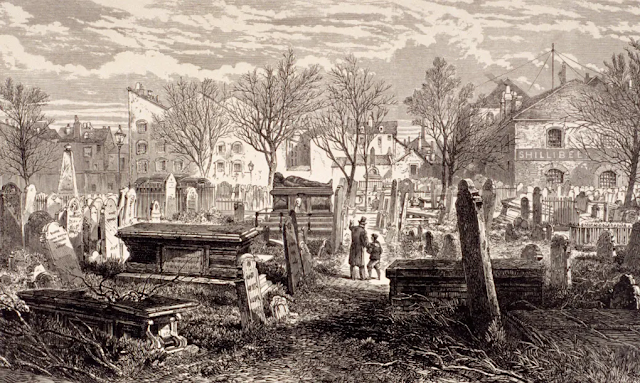
     As the social elite deserted cemeteries, the rising bourgeoisie, comprised of craftsmen and laborers, seized control of the territory and, “no longer content simply to sleep in sanctified ground with no thought of the memory they left behind them,” used their modest means to purchase permanent plots from the church and erect gravestones that began as simple crosses and evolved into elaborate markers modeled after the private monuments of the upper echelons.[1] This act, Ariès reveals, weakened the connection between church and cemetery, reverted the graveyard back to a specialized place for burial (a concept not maintained for a thousand years), and began the gradual move back to the outskirts of the community.[2] Part of this migration, in turn, was driven by the insidious conditions caused by cemetery neglect in the middle of the eighteenth century, with overwrought clergy incapable of keeping pace with growing maintenance and dereliction breeding a slew of sanitary issues, including water contamination, infestations of flies spoiling nearby gardens and farms, air from the common graves leaking into the cellars of neighboring homes, and the effluvium of decay, chiefly during sweltering summer months, plaguing the local residents.[3] While administrative reports like Grande et Nécessaire Police (1619) first brought the problems to light during the seventeenth century, serious legislature was not introduced until a century later, with the Decree of the Parliament of Paris of March 12, 1763, for instance, making demands for improvement yet failing to ensure their applications.[4] Despite these governmental holdups, the relocation of burial grounds outside of city limits continued and, by the nineteenth century, it fostered the creation of rural monuments which served as fashionable resting spots for the dead and popular retreats for the living, who flocked to their park-like grave gardens and elaborate memorials to both honor the deceased and cherish each other through social interactions.[5] In doing so, Ariès reveals, the cemetery readopted its communal nature once established in the Middle Ages.[6]

Works Referenced

Ariès, Philippe. The Hour of Our Death: The Classic History of Western Attitudes Toward Death Over the Last One Thousand Years. 1977. Trans. Helen Weaver. New York: Barnes and Noble Books, 2000.
____________________
[1] Ariès, 272.
[2] Ariès, 320-321.
[3] Ariès, 348-352.
[4] Ariès, 479-491.
[5] Ariès, 531-536.
[6] Ariès, 555-556.

Friday, October 21, 2022

2021's Haunt (Night)

2021: Haunted Cemetery
 
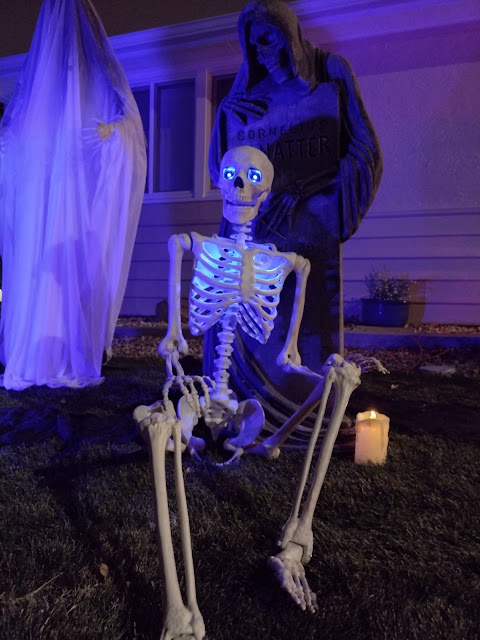
2021 proved a rough year for many people, including myself. I lost my job of seven years and struggled to find employment well until August. With money being scarce, I was unable to build anything and even considered cancelling my Halloween plans; however, family and friends convinced me that doing something spooky for the holiday season would be good for my mental health. So, I gathered up a few staples and created a cemetery on my parents' front lawn. Although it was a rather lackluster display, it did help elevate may waning spirits. Presented here are images of the haunt in all its nocturnal glory (for the daytime images, click here).

Friday, October 14, 2022

"Mr. Macklin's Jack O'Lantern" (A Poem)

Born in 1897, David Thompson Watson McCord was the associate editor for the Harvard Alumni Bulletin, executive director of the Harvard College Fund, and is best known for his numerous anthologies of children's poetry, including Far and Few (1952), Away and Go (1975), and All Small (1986). Many like "Mr. Macklin's Jack O'Lantern" examine the everyday mundane with childlike wonderment.
 
Mr. Macklin takes his knife
And carves the yellow pumpkin face:
Three holes bring eyes and nose to life,
The mouth has thirteen teeth in place.
Then Mr. Macklin just for fun
Transfers the corn-cob pipe from his
Wry mouth to Jack’s, and everyone
Dies laughing! Oh What fun it is
Till Mr. Macklin draws the shade
And lights the candle in Jack’s skull
Then all the inside dark is made
As spooky and as horrorful
As Halloween, and creepy crawl
The shadows on the tool-house floor,
With Jack’s face dancing on the wall.
O Mr. Macklin! where’s the door? [1]
 
Works Referenced
 
McCord, David Thompson Watson. "Mr. Macklin's Jack O'Lantern." Far and Few: Rhymes of the Never Was and Always Is. New York: Little and Brown, 1952. 46.
____________________
[1] McCord, 46.

Friday, October 7, 2022

2021's Haunt (Day)

2021: Haunted Cemetery
 
2021 proved a rough year for many people, including myself. I lost my job of seven years and struggled to find employment well until August. With money being scarce, I was unable to build anything and even considered cancelling my Halloween plans; however, family and friends convinced me that doing something spooky for the holiday season would be good for my mental health. So, I gathered up a few staples and created a cemetery on my parents' front lawn. Although it was a rather lackluster display, it did help elevate may waning spirits. Presented here are images of the haunt by day (always less atmospheric than their nighttime counterparts, but the best means to reveal detail).